Multi-Cat Litter Box Smell: How to Actually Control It
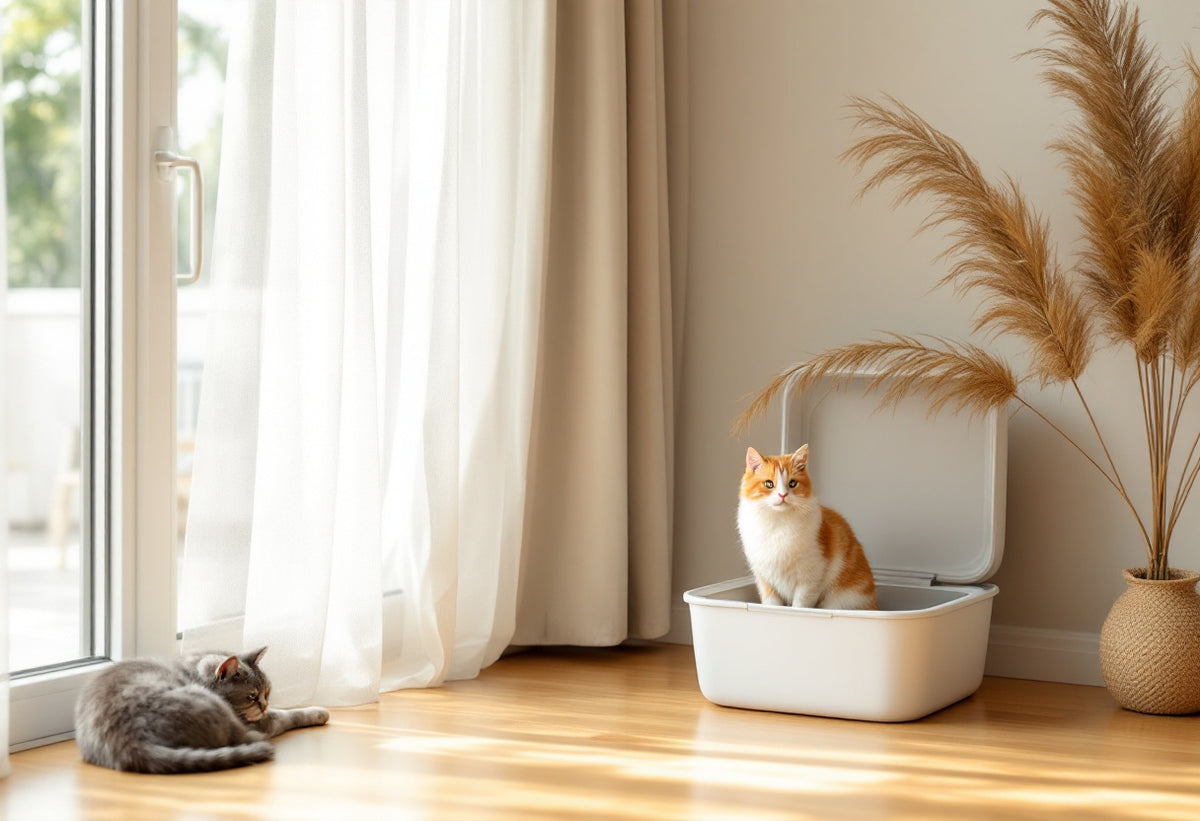
Short answer: multi-cat litter box odor is controlled at three points, not one. Give the household one box per cat plus one extra, spread out in separate rooms; scoop twice a day so bacteria never get the 2–4 hours they need to turn urea into ammonia; and then handle the air itself with real ventilation. Adding a stronger scented litter to a crowded, under-scooped setup only layers perfume on top of the problem.
Why two cats smell like more than twice one cat
Fresh cat urine barely smells. What you're actually smelling is chemistry that happens after the fact. Urine contains urea, which is odorless. Bacteria in the box produce an enzyme called urease that splits urea into carbon dioxide and ammonia gas — and that's the eye-watering part. As waste continues breaking down, sulfur compounds called mercaptans join in, which is the skunky note underneath the ammonia.
Here's the part that catches multi-cat homes off guard: that reaction starts within roughly two to four hours. Cat urine is also unusually concentrated, because cats evolved as desert animals with very efficient kidneys. So a box serving three cats isn't producing three times the smell of a one-cat box — it's producing more waste, more often, with more surface area staying wet longer, which means the bacteria almost never get interrupted.
Once you see it that way, the fix is obvious. You're not fighting a smell. You're trying to keep waste from sitting long enough to become one.
How many litter boxes do you actually need?
The standard veterinary guidance is n + 1: one box per cat, plus one extra. Two cats means three boxes. Three cats means four. It sounds like overkill until you realize each box now gets used less, stays drier, and buys you more time between scoops.
Placement matters as much as the count:
- Separate rooms, not a row. Cats treat two boxes side by side as one big box. Spreading them out actually adds capacity — and reduces the resource guarding that makes a shy cat avoid the box entirely.
- Go bigger than you think. A box roughly 1.5x the length of your largest cat, nose to tail base, gives them room to turn and cover.
- Open beats covered for odor. Hoods trap smell and concentrate it — great until you lift the lid. If you use a covered box in a multi-cat home, scoop it more often, not less.
- Watch your vents. Don't put a box directly under a supply vent blowing down, and keep it a few feet from a return intake. Otherwise your HVAC becomes a very efficient odor distribution system.
The scooping schedule that actually changes things
Once daily is the floor. In a busy multi-cat home, twice a day is the number that makes a visible difference — it keeps most deposits under that two-to-four-hour bacterial window.
Beyond scooping: keep 1–3 inches of litter depth so urine clumps instead of pooling on the plastic, top off what you remove, and do a full dump plus a soap-and-water wash of the box about once a month. Plastic that's been scratched up over years holds odor no matter how well you clean it, so plan on replacing boxes periodically.
One more thing that's easy to miss: hydration. Cats with steady access to fresh water produce more dilute urine, which is simply less pungent. Multiple water stations in a multi-cat home is a small change with a real payoff.
Picking litter for a multi-cat home
Most cats prefer unscented, fine-grained clumping litter. Heavily perfumed litters are marketed at people, not cats — and a cat who finds the box unpleasant may start going somewhere else, which is a far worse odor problem than the one you were trying to solve.
If you want extra help at the litter level, plain baking soda or an activated-carbon additive is generally better tolerated than a strong fragrance. The goal is neutral, not floral.
What about the air in the room?
Even a well-run box loses some odor to the room, and in a small apartment or a closed powder room it has nowhere to go. Ventilation is the first lever: crack a window, run the bathroom exhaust fan, keep the air moving. A dehumidifier helps too — damp air holds odor and slows down how fast the litter surface dries.
When passive airflow isn't enough, some households add a device that treats the air itself. Our Cat Litter Odor Deodorizer works this way: it uses ozone to oxidize odor molecules like ammonia rather than covering them, plus negative ions to help settle fine airborne dust. Because ozone shouldn't be running around a cat that's actively using the box, it has a pet sensor that pauses output when a cat comes within about two meters, then resumes once the area is clear.
A device like this is a supplement, not a substitute. If the boxes are under-scooped and overcrowded, no air treatment is going to save the room. Fix the box math first, then let the deodorizer handle what's left over.
When the smell is a health signal, not a housekeeping one
Sometimes odor changes because a cat has changed. A sudden shift in urine smell, a big jump in volume or frequency, straining, or a cat who starts avoiding the box altogether are all worth a call to your vet. Urinary issues are common in cats and are one of the few odor problems no amount of scooping will fix. This is especially true in older cats — and if you're managing an aging household generally, our senior essentials collection is a good place to start.
A simple weekly rhythm
- Twice daily: scoop every box.
- Daily: refresh water bowls, quick sweep of tracked litter.
- Weekly: top off litter to 1–3 inches, wipe box rims and the floor around them.
- Monthly: full litter change and box wash with unscented soap and water.
- Ongoing: keep the room ventilated; run an air deodorizer if the space is small or enclosed.
None of this is dramatic. That's sort of the point — multi-cat homes that smell fine aren't doing anything clever, they're just doing the boring things on schedule. If you want to know how we source and test what we make, you can read more on our trust center.
Frequently asked questions
How many litter boxes do I need for 3 cats?
Four — the standard guidance is one box per cat plus one extra. Place them in separate rooms rather than lined up together, since cats treat adjacent boxes as a single box.
How often should I scoop in a multi-cat household?
Twice a day. Bacteria start converting urea into ammonia gas within about two to four hours, so scooping twice daily keeps most waste from reaching the smelly stage.
Does scented litter help with multi-cat odor?
Not really. Fragrance masks odor rather than removing it, and strong scents can make sensitive cats avoid the box — which creates a bigger odor problem elsewhere in the house.
Is a covered litter box better or worse for smell?
Covered boxes contain odor in the short term but trap moisture and concentrate it inside. In multi-cat homes, open boxes ventilate better and most cats prefer them.
Is an ozone deodorizer safe around cats?
The Ladnut Cat Litter Odor Deodorizer includes a pet sensor that pauses ozone output when a cat is detected within about two meters. Use it as directed in a ventilated space, and treat it as a supplement to regular scooping rather than a replacement.
Why does my house still smell after I clean the boxes?
Odor can linger in soft surfaces, in scratched-up plastic boxes, or in poorly ventilated rooms. Replace old boxes periodically, improve airflow, and check with your vet if one cat's urine smell has changed noticeably.
The Ladnut Cat Deodorizer is an electronic device; its sensor pauses ozone output when a pet is detected within ~2 meters. Use as directed and keep out of reach of small children.