Are Cat Litter Deodorizers Safe for Cats?
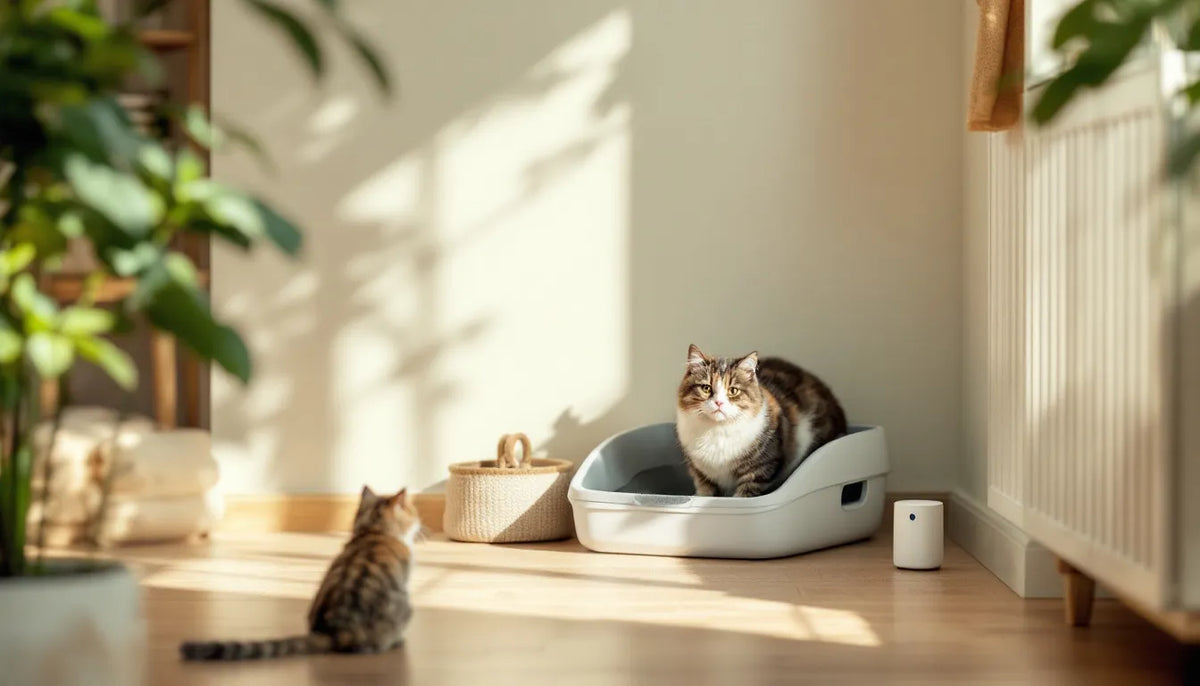
Short answer: It depends entirely on the type. A high-output ozone generator meant to flood a whole room is not something you should run with your cat in the space. But a low-output, sensor-controlled litter deodorizer that pauses when your cat comes close is a different tool built for a different job. The safest setup pairs a well-designed device with the habits that actually keep odor down: enough boxes, daily scooping, and good airflow.
What people mean by “cat litter deodorizer”
The phrase covers two very different things, and lumping them together is where most of the confusion starts.
- Additives — baking soda, activated-carbon granules, or scented crystals you mix into the litter. These work at the surface of the box.
- Electronic devices — small units that sit near the box and treat the air around it using negative ions and, in some cases, a small amount of ozone.
When people ask whether litter deodorizers are “safe,” they’re almost always thinking about that second group — the electronic ones — because ozone has a real safety story worth understanding.
Are ozone and ionizer devices safe for cats?
Here’s the honest version. Ozone is a lung irritant. In high concentrations, it can bother a cat’s eyes, nose, and airways, and cats have more sensitive respiratory systems than we do. That’s why the California Air Resources Board advises against running powerful ozone-generating machines in occupied spaces. Those industrial units are designed to saturate a room, and the guidance is clear: people and pets should be out while they run.
Negative-ion output is a gentler mechanism. Ions attach to airborne particles and odor molecules, causing them to clump and settle instead of lingering in the air you and your cat breathe. The catch is that it’s hard to produce ions without producing at least a trace of ozone, which is why certified devices are held to strict limits — well below the levels considered a concern for continuous indoor use.
So the real question isn’t “ozone — yes or no?” It’s “how much, and does the device keep my cat out of its path?” A trickle of output that pauses when your cat approaches is a completely different exposure than a room-flooding generator running while your cat naps three feet away.
How the Ladnut Cat Deodorizer is designed around your cat
We built the Ladnut Cat Litter Odor Deodorizer with that distinction in mind. It combines negative ions with a low, controlled ozone output aimed at the air right around the box — not a whole-room blast. The key feature is a smart pet-safe sensor: when your cat comes within about two meters, the device pauses its ozone output, then resumes once your cat has wandered off.
In practice, that means it does its work in the quiet moments between litter-box visits, when the box is sitting there off-gassing and no one’s around. It’s meant to be used as directed and kept out of reach of small children. If you want to see how we think about ingredients, testing, and honest product claims across the brand, our Trust Center lays it out.
A device like this is a helper, not a substitute for cleaning. Which brings us to the part that matters most.
The odor fix that matters most is your routine
Litter box smell is mostly ammonia. Urea in your cat’s urine gets broken down by bacteria into ammonia gas, and warmth, moisture, and stale air all speed that up. No device fixes a box that isn’t being cleaned often enough — it just masks it. Get the fundamentals right and any deodorizer has far less to fight:
- Follow the n+1 rule. One box per cat, plus one extra. It’s the guideline feline veterinarians and behaviorists point to, and it keeps any single box from becoming an ammonia factory.
- Scoop at least once a day — twice is better, especially in a multi-cat home, where odor builds faster than a once-a-day schedule can keep up with.
- Do a full litter change and wash monthly. Empty the box, wash it with mild soap and warm water, dry it, and refill.
- Help with airflow. A covered box can trap heat and moisture and concentrate the smell. If odor builds under the hood, try an open design or move the box somewhere better ventilated.
- Consider an odor-locking litter or carbon. Clumping clay with odor control or a spoon of activated carbon traps gases before they spread.
A simple low-odor setup
If you want a starting point: give each cat their own box plus one spare, spread the boxes across different rooms rather than clustering them, scoop morning and night, and keep the area ventilated. Add a deodorizer to handle the ambient smell that lingers between cleanings. That layered approach — good habits first, device second — is what keeps a home genuinely fresh rather than perfumed over a problem. You can find our litter odor deodorizer here if you’d like to add one to the mix.
One last note: a sudden, unusually strong ammonia smell can sometimes point to more concentrated urine. If you also notice your cat straining, crying in the box, drinking or urinating much more than usual, or losing weight, that’s a conversation for your veterinarian rather than a deodorizer.
Frequently asked questions
Are cat litter deodorizers safe for cats?
Additive deodorizers like baking soda and activated carbon are generally considered safe. Electronic devices are safe to the degree they limit ozone and keep it away from your cat; avoid running high-output ozone generators in a room while your cat is present.
Is ozone dangerous for cats?
In high concentrations ozone can irritate a cat’s eyes, nose, and airways. Small, controlled outputs that pause when your pet is nearby are a very different exposure than an industrial ozone generator flooding an occupied room.
How does the Ladnut deodorizer avoid exposing my cat?
It uses a pet-safe sensor that pauses ozone output when a cat is detected within about two meters, then resumes once the cat moves away, so it treats the air mainly when the box is unattended.
Do deodorizers replace scooping?
No. Litter odor is mostly ammonia from accumulating waste, so daily scooping and a monthly full change do the heavy lifting. A deodorizer handles the lingering ambient smell.
How many litter boxes should I have?
The common veterinary guideline is one box per cat plus one extra, placed in different areas so your cats always have a clean option.
Why does my litter box smell worse in summer?
Heat and humidity speed up the bacterial breakdown of urea into ammonia, so the same box smells stronger. More frequent scooping and better airflow help.
The Ladnut Cat Deodorizer is an electronic device; its sensor pauses ozone output when a pet is detected within ~2 meters. Use as directed and keep out of reach of small children.